How much nitrogen does it take to pig a pipeline?
Nitrogen is usually the largest single cost line on a pre-commissioning job, and the quantity is almost always argued about after the fact. It is a two-step calculation, and neither step is difficult.
Step one: the line volume
The geometric volume is V = A × L, with A = π/4 × ID². A 12-inch standard wall line, 10 km long, holds 0.0730 m² × 10,000 m = 730 m³. That number is the same whatever you put in it.
Step two: convert to what the supplier sells
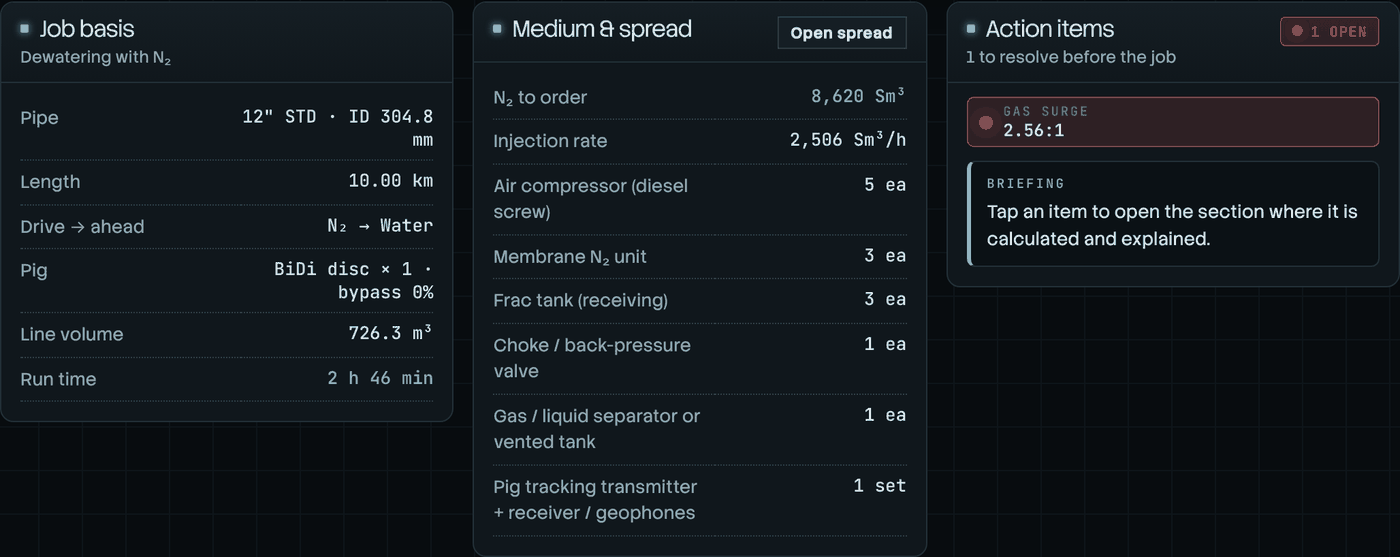
Nitrogen is bought in standard cubic metres — the volume it would occupy at 15 °C and 1.01325 bar. Gas in a pressurised line is compressed, so one line volume costs many standard volumes:
Vstd = Vline × (Pabs / Pstd) × (Tstd / T) × (1 / Z)
For nitrogen at normal pigging pressures Z is within a percent or two of 1, so the pressure ratio does nearly all the work. That same 12-inch line, filled at 8 bar g, holds about 6,500 Sm³.
| Line, 10 km | Line volume (m³) | at 4 bar g (Sm³) | at 8 bar g (Sm³) | at 16 bar g (Sm³) |
|---|---|---|---|---|
| 6" std wall | 186 | 923 | 1,659 | 3,131 |
| 8" std wall | 323 | 1,597 | 2,872 | 5,421 |
| 10" std wall | 509 | 2,518 | 4,527 | 8,546 |
| 12" std wall | 730 | 3,611 | 6,492 | 12,255 |
| 16" std wall | 1,178 | 5,830 | 10,482 | 19,785 |
| 20" std wall | 1,878 | 9,290 | 16,702 | 31,526 |
| 24" std wall | 2,739 | 13,552 | 24,364 | 45,990 |
What you hold is not what you consume
Two different numbers get called "the nitrogen quantity", and mixing them up is how jobs run short:
- Peak inventory — the gas in the line at any moment. That is the table above. It decides the bottle bank or the size of the liquid nitrogen storage.
- Total consumed — everything that passes through the line over the run. If the receiving end vents while the pig travels, you pay for roughly a line volume at run pressure for each pass, plus purge and hold. A dewatering run followed by a drying run followed by a nitrogen packing hold can be three to five times the single-fill figure.
Membrane units are rated in Nm³/h at a stated purity — and the rating falls as you ask for higher purity from the same machine. Work out the flow you need for pig speed first (that is the duty), then divide by the unit rating at the purity your specification demands, then add a spare unit. Purity and flow are traded against each other on the same skid; booking on flow alone is how a spread arrives that cannot make 99.5 %.
If it comes as liquid
One litre of liquid nitrogen makes about 0.69 Nm³ of gas. A 20,000-litre road tanker is therefore roughly 13,800 Nm³ — a little over two fills of the 12-inch line above at 8 bar g. Vaporiser capacity, not tanker capacity, usually limits how fast you can deliver it, and a vaporiser that ices up delivers cold gas that reads as a flow shortfall.
When compressed air will do instead
Air is free; nitrogen is not. Air is normally acceptable for hydrotest dewatering and for cleaning runs on a line that has never been in hydrocarbon service and will be purged before commissioning. Nitrogen is used where an oxygen-free atmosphere is required — a line going straight into hydrocarbon service, a line being packed and left, or anywhere the specification calls for an inert hold. If the line will hold gas for weeks, dew point matters as much as purity: wet air in a carbon steel line starts corroding immediately.
Pipeline pigging calc & planner
It works out the line volume, the standard volume at your pressure and temperature, the peak inventory and the consumption for the job type you pick — nitrogen, air or water.
Open the pigging calculatorWho writes this. A mechanical engineer with twelve years in oil and gas — in-line inspection, fired heater and furnace inspection, and pipeline integrity. What is here comes from the published standards and from what those years in the field actually looked like. It is not written by an API-certified inspector.
This is not an assessment. Nothing on this site may be used to justify a decision about real equipment. Assessing plant requires the current editions of the applicable codes, data from a licensed source, and a competent engineer who signs for the answer. · Integrity Field Guide · Pipeline pigging calculator · Pigging equipment & vendor directory · Pipe & fitting dimensions
Pictures: “Acid-corrosion-in-a-flue-gas-duct-01” by CEphoto, Uwe Aranas, CC BY-SA 3.0, via Wikimedia Commons; “Anacortes Refinery 31911” by Walter Siegmund (talk), CC BY 2.5, via Wikimedia Commons; “United States Strategic Petroleum Reserve 072” by ENERGY.GOV, public domain, via Wikimedia Commons; “Trans-Alaska Pipeline System Visitors Center Scraper Pig” by Leijurv, CC BY-SA 4.0, via Wikimedia Commons; “Gulf raffinaderij, Rozenburg, Bestanddeelnr 924-8259” by Hans Peters for Anefo, CC0, via Wikimedia Commons.


